
Review · NEW YORK CITY TOURS
Big Bus NYC: Hop-On Hop-Off Sightseeing Tour by Open-top Bus
A good first day in NYC needs a simple plan. This hop-on hop-off bus tour is built for exactly that, with open-air sightseeing plus guided audio that helps you connect neighborhoods fast.
I love the flexibility. You can ride the whole loop or hop off when something grabs you, then jump back on later with the same ticket. I also like that it is designed to cover a lot of ground without you needing to line up reservations for every stop.
The audio commentary is the other big reason this works. You get stories as you pass famous landmarks, and you are not stuck reading plaques in the cold or rain. On many days, that means you are actually learning while you travel, not just moving from one photo spot to the next.
One drawback to plan around: the ride can feel a bit “transport first, host second.” Some departures have spotty audio or limited headphones, and bus spacing can vary with traffic and weather, so you may wait more than you expect at a stop.
Key points before you board
- Two loop choices: Downtown (Red) only on a 24 hour ticket, then add Uptown (Blue) with 48 hours.
- Longer ticket, more options: a 72 hour ticket also adds Brooklyn tours and extra self-guided walking tours.
- Audio + live tracking: use the Big Bus app to follow where buses are, and listen with the onboard audio.
- Stops that match your priorities: Empire State, Flatiron, SoHo, Chinatown, Wall Street, plus Central Park area sights.
- Timing can swing: official spacing is around hourly, and street traffic can stretch that out.
How the Big Bus NYC loop helps you get oriented fast
If you are landing in NYC and feeling like the streets are a maze, this kind of hop-on hop-off is a practical shortcut. Instead of guessing which subway line gets you closest to your must-sees, you get a high-level map of Manhattan and key “outer” sights along the way.
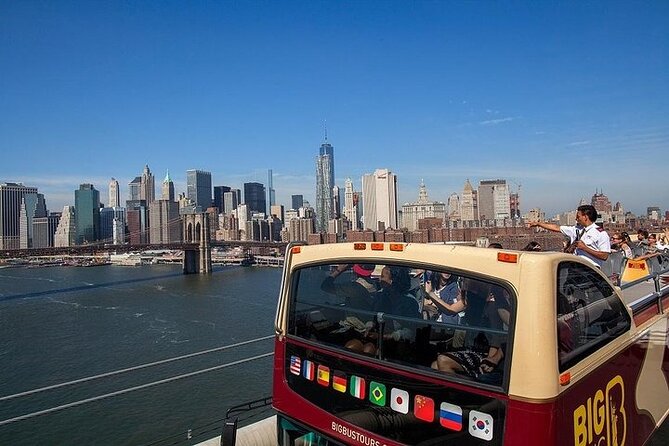
The open-top double decker matters more than you might think. You will actually see across avenues and down toward the skyline, especially in the Midtown-to-Harbor stretch. Yes, it is cold in winter and hot in summer. That is NYC. But at least you control your exposure by hopping off at the moment you want a break.
I also like that the stops are placed on major corners, not hidden inside a park. You can plan walks that feel doable, like stepping off near Midtown landmarks, then returning later instead of committing to an all-day sightseeing sprint.
You can also read our reviews of more tours and experiences in New York City.



Picking the right ticket: 24, 48, or 72 hours
Start with your time on the ground. If you only have about a day and you mainly want Manhattan highlights, the 24 hour Downtown route style of plan is a clean fit. If you want a mix of Midtown and Uptown, you will want the 48 hour option so you can ride both loops.
Here is the simplest way I think about it:
- 24-hour ticket: good for first-time highlights, with the Downtown loop covering Times Square through the Financial District and toward the harbor area.
- 48-hour ticket: best for most visitors because it adds the Uptown loop, bringing you up into Central Park-adjacent areas and classic Midtown.
- 72-hour ticket: for people who do not mind stretching the trip a bit and want extra add-ons. You get access to Brooklyn tours and more self-guided walking options in addition to both loops.
Also, note this detail that can trip you up: multi-day tickets are meant to be used consecutively. If your schedule has a break in the middle, you may waste validity rather than saving money.
Downtown loop focus: Times Square to the harbor stops
Your Downtown loop is where NYC first-timers usually feel the most “wow” per mile. Expect it to move through the loud, iconic center of Manhattan, then drift toward landmarks tied to the harbor and skyline.
Here are the stop-by-stop vibes and what to watch for:
M&M’S New York, 7th Ave at W 48th St
This is an easy first stop because it is right in the Times Square orbit. If you have kids or you like kitschy fun, it is a quick detour. It is also useful as a meeting point on a chaotic day.
Tip: treat it as a warm-up. You will get better “big views” later on the route.
Times Square, W 42nd St and Broadway
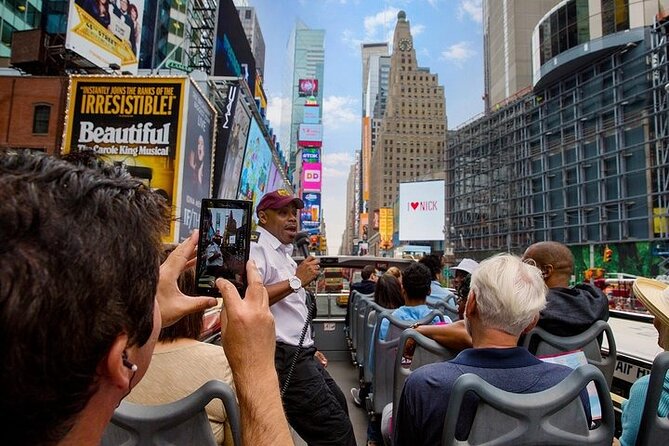
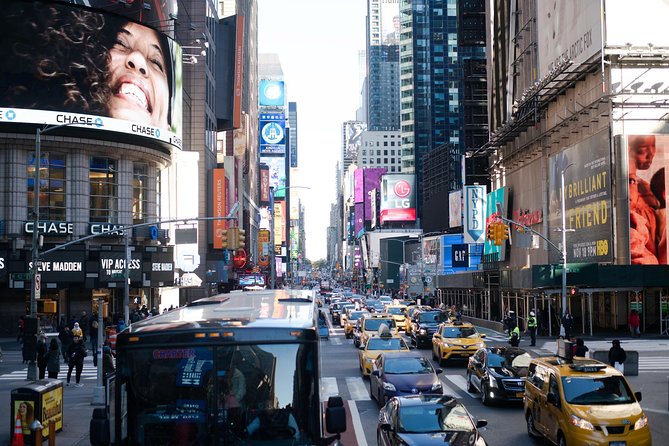
Times Square from the top deck hits hard because the energy is constant and the buildings are huge. The upside is easy photos. The downside is that it can feel crowded and overstimulating, so pick a short stop, grab what you came for, then move on.



Empire State Building area, 5th Ave at W 32nd St
This is one of the strongest “landmark recognition” stops. Even if you do not go inside, the skyline angles are worth it, and it helps you place Midtown geography in your head.
If you want a longer break, this is a good candidate. If you just want the view, stay on and let the next blocks roll by.
Flatiron District, 5th Ave at W 23rd St
Flatiron is one of those neighborhoods where a quick look from the street feels like a story. From the bus you get a clean view of the building shape and the flow of the area.
This is a decent hop-off spot if you like walking and people-watching, but it can also be busy, so keep your stop time tight.
SoHo, West Broadway and Spring St near Nike
SoHo is where your “NYC style” instincts kick in. Think shopping streets, historic building facades, and that mix of trendy and classic.
Practical move: hop off, browse one block deeper than you planned, then reboard rather than trying to cover the whole neighborhood in one go.
Chinatown / Little Italy, around 100 Lafayette St
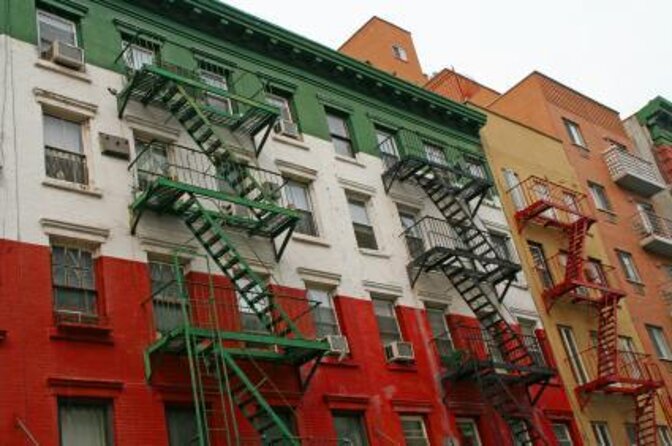
This is your food-and-street-life zone. You get the vibe of two cultures close together, plus lots of sights that are better enjoyed on foot.
Drawback: the streets are narrow and the bus stop may be a short walk from the exact place you want. If you are picky about exact sight lines, use the walking minutes as part of your plan.
Brooklyn Bridge area, Park Row and Beekman St
This is one of the stops that can be more useful than it looks, because you can decide how ambitious to be. You might just view, or you might walk toward the bridge edges depending on time and energy.
One caution: the bridge is a big visual target, but the bus stop itself may be at a distance. Plan for a short walk if your goal is a specific bridge angle.
Wall Street / Statue of Liberty area, near Wall St
This stretch sets you up for the Financial District feel, plus it is near the theater of harbor icons. It is a good place for photos that show you how NYC’s “power block” sits next to the broader skyline.
Trinity Church area, Trinity Place and Cedar St
This stop is a helpful landmark anchor. Even if you are not aiming for a full harbor day, it puts you in a spot that is good for understanding where the island edges and historic core connect.
World Trade Center area, Church St and Vesey St
This is a high-impact stop because it is a major skyline moment. You also get the sense of a city constantly rebuilding around its history.
If you are sensitive to the mood here, keep your visit brief and focus on what you want to absorb.
Pier 57, 11th Ave between W 15th and W 16th St (near NBC building)
Piers are where NYC shifts from “street grid” to “waterfront scale.” Pier 57 is also a convenient jump-off for people who want to add a short harbor walk or transit to cruise-type activities.
Hudson Yards, 12th Ave at 30th St (north-east corner)
Hudson Yards is your modern NYC contrast. It is big architecture, wide open spaces, and the sense of a whole new district built to pull you forward.
If you love current design and new skyline perspectives, this is a stop worth spending time at.
Circle Line Sightseeing Cruises, 12th Ave at 40th St (opposite Pier 81)
This stop is strategically placed if you want to add a boat ride. Even if you do not take it that day, having it on your bus route makes planning much easier.
It is one of those “I might do it, I might not” stops. Keep it flexible.
Uptown loop: Rockefeller, the Met zone, Central Park, Carnegie Hall
When the route turns Uptown, the feel changes. You trade some of the loud density for iconic Midtown landmarks and the edges of Central Park, then push into classic cultural corners.
Here is what the Uptown loop brings:
Hope Sculpture, 7th Ave at W 53rd St (front of Chase Bank)
This stop is a quick visual reset in the Midtown bustle. It is useful for orienting yourself in the 50s and for breaking up a long riding stretch.
Times Square again, 42nd St and Broadway (in front of the Knickerbocker Hotel)
You are back near a familiar hub, which is useful if you hopped off before and need to rejoin the loop easily. It also gives you a second angle at the same area, which can be surprisingly helpful when you are mapping NYC in your head.
Rockefeller Center, 5th Ave and W 49th St
This is one of the most classic Midtown “set pieces.” Even if you do not go inside anything, you get the geometry of the plaza and the skyline framing.
This stop is also a great place to pick up a guided walk afterward, because everything around it is walkable.
The Metropolitan Museum of Art, 5th Ave and E 83rd St (outside the museum near 83rd St)
This is the museum-adjacent marker. If you are museum-curious, the hop-off position helps you decide quickly if you want to spend hours inside or just do a quick exterior look.
Practical caution: depending on your interests, the time decision can balloon. If you do not want that, set a time limit for yourself before you hop off.
Central Park Zoo, 5th Ave and E 66th St (opposite 845 5th Ave)
This is a family-friendly stop with clear purpose. If you are traveling with kids, it is an obvious connection point.
If you are visiting as an adult and not planning a zoo visit, the real value is being near Central Park edges, which you can then use to plan a walk.
Columbus Circle, Central Park and Columbus Circle (southwest corner)
Columbus Circle is a classic “gateway” point. It is also a strong place to reposition between neighborhoods without committing to a long subway transfer.
Tip: if you want one easy Central Park moment, this is a solid starting location.
Carnegie Hall, 7th Ave and W 57th St
This stop is for culture lovers and for those who like seeing the Midtown icons up close. Even if you are not catching a show, the area is worth a quick hop-off.
In winter or rain, I like this kind of quick stop because it gives you a sense of the city without requiring a long walk.
The audio, headphones, and onboard experience reality check
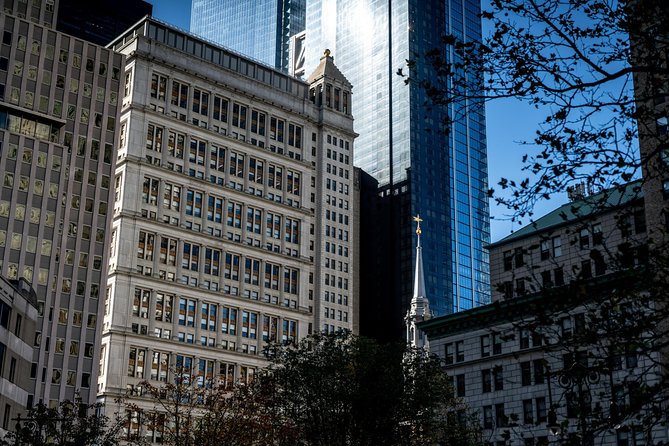
The bus is built around audio commentary. That is the core promise, and when it is working well, it turns the ride into something more than a slow ride through traffic.
A key practical point: audio access can vary. Some buses may have headphone supplies or audio that does not perfectly match what you are seeing outside. On the best rides, staff and drivers can make the experience feel more human. I have seen names like Ms Copeland and Santana pop up as standouts, with narration that adds local color and practical tips.
So here is how you should handle it:
- Be ready to get headphones at the right moment, and check the audio immediately after you board.
- Keep one ear for the audio and one eye on stop announcements, because in busy moments you might need to confirm where you are.
- If the audio is quiet or off, do not panic. Use the stop map and signage, then rely on your own quick research for the deeper story.
Also, this is important if you are photo-minded: some windows can make viewing tricky. If you can, sit upstairs where sight lines are best, and avoid being blocked by tall passengers.
Price and value: is $44 worth it
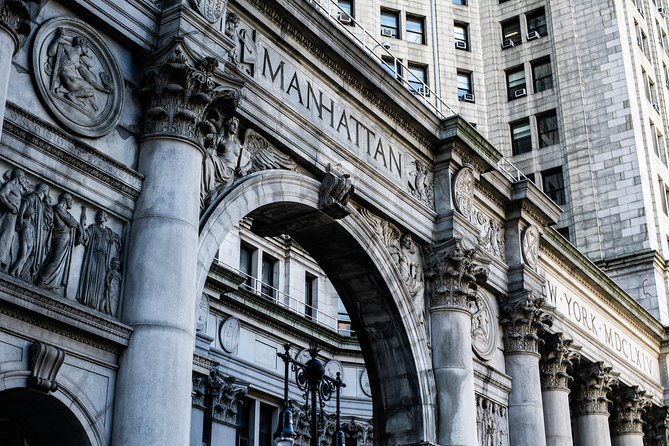
At about $44 per person for the base experience, the value depends on how you plan to spend your time.
Here is the math I use:
- If you are a first-timer who wants a quick overview and you will likely take taxis, subways, and walking anyway, this can be cheaper than it looks because you reduce the number of “dead end” trips.
- If you are traveling with a tight schedule, the hop-on hop-off format saves energy. It is not about comfort. It is about time and decision-making.
- If you already know the neighborhoods you want and you plan to do subway and walking only, the bus may feel like an expensive taxi substitute.
The best value comes when you actually use the flexibility. Hop off, do one planned activity, then reboard. If you stay on the entire way and never exit, you are paying for a ride that you could almost do by just riding a subway line and saving money.
When the service is smooth, and when it gets messy

This type of tour lives and dies by timing.
On paper, buses arrive roughly every hour on both Downtown and Uptown loops. In real life, traffic, weather, and day-by-day operations can change the waiting time at stops. Street closures can also mess with pickup spots, so you might be walked to a nearby stop line.
I also recommend you treat stop finding like a real task. The app can help, but it is not enough to assume. Stand signage, stop lists, and the color of the route matter. It is very easy to be in the right area and still at the wrong stop line.
If you get confused, the fastest fix is usually to go to the staff member at the stop you are actually at, confirm which loop you are on, and ask where the next bus for your line will load.
Who this is best for
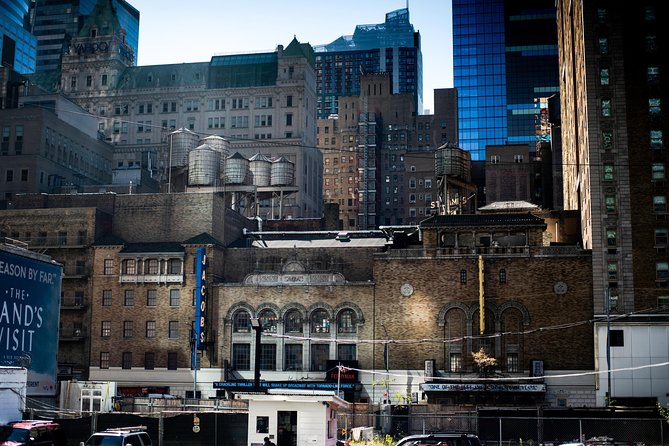
This is an excellent match if you are:
- Visiting for the first time and want major highlights with minimal planning
- Short on energy and prefer to sit while getting orientation
- Traveling with kids, older relatives, or anyone who might tire out from long walks
- Interested in pairing the bus with extra add-ons like cruises from the pier stop area
It might be less ideal if you:
- Want highly personal interaction with a live guide throughout every minute
- Are extremely sensitive to audio quality and want everything perfectly aligned outside your window
- Plan to do only a few stops and then deep neighborhood exploration on foot for the rest of the day
Small rules that affect your comfort
A few practical details can change the ride experience:
- The buses are open-top, so dress for wind and temperature swings.
- No food or alcohol on board, but non-alcoholic drinks in screw-top bottles are allowed.
- Luggage is not permitted onboard.
- Service animals are allowed.
- No pets are allowed, other than ADA service animals.
You will feel these rules most if you bring a lot of gear. Pack light, and plan meals around hop-off stops.
Should you book Big Bus NYC?
I think you should book this if your main goal is to get your bearings fast and see the big NYC icons without turning your day into a logistics puzzle. For most visitors, the value lands when you use both loops or you stretch to a 72-hour ticket and actually add a few extra activities.
You should consider skipping or swapping to a different plan if your schedule is ultra-tight, your priority is one neighborhood only, or you hate uncertainty around stop timing. Also, if you are traveling on a winter day, keep an eye on weather. Service can be canceled due to poor weather, and you do not want to lose half a day with no backup.
If you do book it, my best advice is simple: choose your ticket based on the neighborhoods you truly want, then be bold about hopping off for short walks. The tour is most rewarding when you treat the bus as your moving map, not your whole day.
FAQ
How long does a full loop take?
A full rotation on each of the Downtown (Red) and Uptown (Blue) routes is approximately 90 minutes.
How often does a bus arrive at each stop?
A bus arrives approximately every hour on both the Downtown (Red) and Uptown (Blue) routes.
Can I redeem my ticket at any stop?
Yes, you can redeem your printed or electronic ticket at any of the listed bus stops.
Do I have to pick one specific stop to start?
No. You can board at any of the listed stops and then hop on and off along the route.
How do I know which stops are coming up?
The onboard communication will share upcoming stops, and you can also use the Big Bus app for route and time information.
Is the tour wheelchair accessible?
Yes. Wheelchair-accessible vehicles with lifts are available and can accommodate up to 650 pounds.
Are pets allowed on board?
Pets are not allowed onboard, except ADA service animals.
Are food and alcohol allowed on the bus?
No food or alcohol is permitted onboard. Non-alcoholic drinks in screw-top bottles are permitted.
Is luggage allowed on board?
No. Luggage is not permitted onboard at this time.
More Tours in New York City




More Tour Reviews in New York City
Not for you? Here's more nearby things to do in New York City we have reviewed











More New York City Tours to consider.
 ★ 4.7SUMMIT One Vanderbilt TicketsTickets from $4751,195 traveller reviews
 ★ 4.7Empire State Building Tickets – Observatory & MuseumTickets from $4725,757 traveller reviews
 ★ 4.6Statue of Liberty & Ellis Island with FerryTickets from $1918,683 traveller reviews
 ★ 4.5American Museum of Natural History TicketTickets from $3715,447 traveller reviews
 ★ 5.0New York in One Day Guided Sightseeing TourTickets from $9913,166 traveller reviews
 ★ 4.6Museum of Modern Art (MoMA) Entry TicketTickets from $3012,540 traveller reviews
 ★ 4.7One World Observatory Skip-the-Line TicketTickets from $3012,329 traveller reviews
 ★ 4.7New York CityPASS®: Save up to 41% at 5 Top AttractionsTickets from $15410,548 traveller reviews