
Review · MANHATTAN TOURS
Manhattan’s Famous Artists: Exploration Game and Tour
Want art stories without the tour-group hassle? This self-guided city game turns Greenwich Village into a walkable museum of artists and performers, with prompts you follow at your own pace and time. I especially like that you get to explore on your schedule and you do not need internet to play. One drawback to plan for, though, is that a couple of key stops can have admission costs that are not included.
You start at White Horse Tavern and end near The Bitter End, taking in famous addresses, music history, and literary lore along the way. It is a private experience, with no physical guide, so you get flexibility and less crowd pressure, but you will be doing the job of moving from clue to clue with your phone.
Quick hits: what makes this Manhattan artists game fun

- Offline play means you can keep moving even with spotty service
- Private, no human contact style makes it feel calmer than a standard group tour
- Short 10-minute stops help you build a route that fits your day, even with snack breaks
- Real locations with real names like Jimi Hendrix, Suze Rotolo, and Edgar Allan Poe
- Start anytime, resume later lets you pause for coffee and jump back in
How the game works, and why it fits real travel days
This is not a guided walking tour where you march with a stranger holding a microphone. Instead, you play a city game at your own tempo, using a mobile ticket and the game on your device. You can start at any hour and take a break when you want, then resume later.
I like this format because it matches how Manhattan days actually go. You can linger outside a building, duck into a shop, or pause for a bite without worrying you are holding up a group. And with offline play, you are not stuck checking your signal every few minutes.
It is also a private activity, meaning only your group plays. If you are the type who hates being funneled into crowds, this style helps you avoid the constant stop-and-go choreography.
More NYC tours and experiences for the shortlist



Your walking route: from White Horse Tavern to The Bitter End
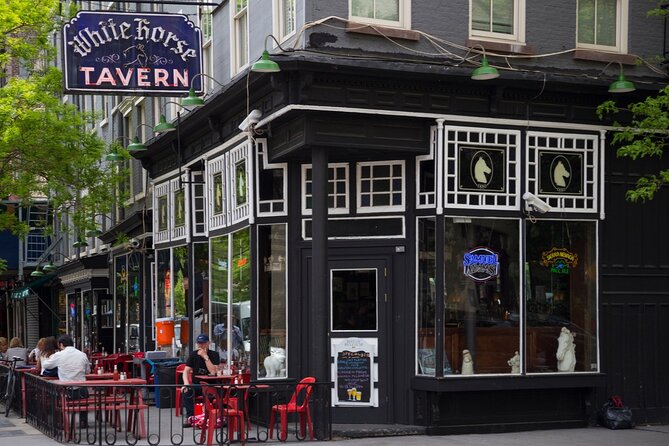
Your adventure begins at White Horse Tavern, 567 Hudson St, and it ends at The Bitter End, 147 Bleecker St. The game is designed around a Greenwich Village route, so you get that classic neighborhood feel, with compact distances between stops.
The total time is about 1 hour 30 minutes on average, with each stop set for roughly 10 minutes. In real life, you may take a bit longer if you read closely, watch your step on busy sidewalks, or stop for food. Still, the short stop timing is smart, because it gives you built-in “mini breaks” without derailing the whole plan.
One more practical note: some locations you will pass are free to view from the street or are listed as free, while others may involve admission if you choose to go inside. That matters for planning your time and budget.
Stop at Lucille Lortel Theatre: a 1926 cinema turned stage
Lucille Lortel Theatre sits at 121 Christopher Street in the West Village, and the building has a layered life. It was built in 1926 as the New Hudson, later known as Hudson Playhouse, and the interior has largely stayed the same.
In the early 1950s, it shifted roles again when the site became an off-Broadway theater called Theatre de Lys, opening June 9, 1953. That opening included a production of Maya by Simon Gantillon, starring Kay Medford, Vivian Matalon, and Susan Strasberg.
This stop is valuable because it teaches you to see theaters as living history, not just photo backdrops. You get context for why these rooms feel familiar even when the productions change. Just remember that admission is listed as not included here, so if you want to go inside, plan for that additional step.
One Sheridan Square: Suze Rotolo and the folk-scene geography
At 1 Sheridan Square, you get a real address tied to Suze Rotolo. She lived in the penthouse of One Sheridan Square with her mother, and just below, on the floor beneath, Miki Isaacson, described as the folk den mother, lived in a tiny studio apartment.
What I like about this stop is how it turns a building into a social map. You stop thinking of Greenwich Village as one big vague “artist area,” and you start seeing it as a network of rooms, floors, and daily routines. That makes the rest of the walk more meaningful, especially if you like music and literary history.
This location is listed as free, so it is a good moment to keep your pacing smooth. If you want to stretch and breathe, this is a friendly place to do it.
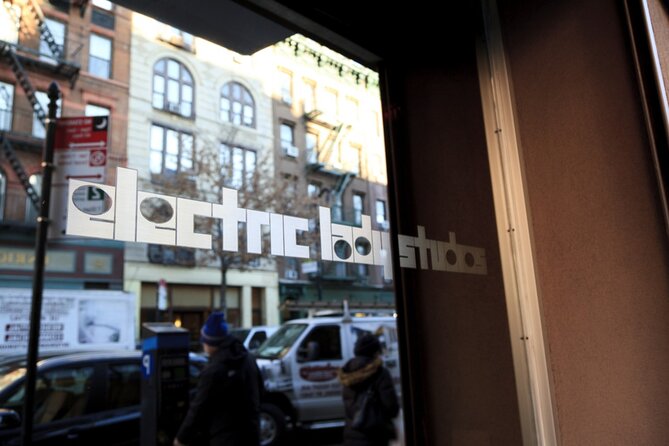
Electric Lady Studios: Jimi Hendrix, design brains, and recorded sound
Electric Lady Studios is at the center of late-60s music lore, and you get the essentials here. The studio was commissioned by rock musician Jimi Hendrix in 1968, and by 1970 it was designed by architect John Storyk and audio engineer Eddie Kramer.
This is one of those stops where the location matters, because studios are not just rooms. They are built decisions about sound, workflow, and how music gets captured. Hearing those names tied to the space helps you understand why Electric Lady became such a landmark for artists who wanted control over their recordings.
The listing notes admission is not included, so if you are hoping for more than a quick look from outside, factor that in. Even without going in, the learning payoff is strong because you leave with names and dates, not just vibes.






40 W 8th St and the Bon Soir: comedy under a “forbidden” mood
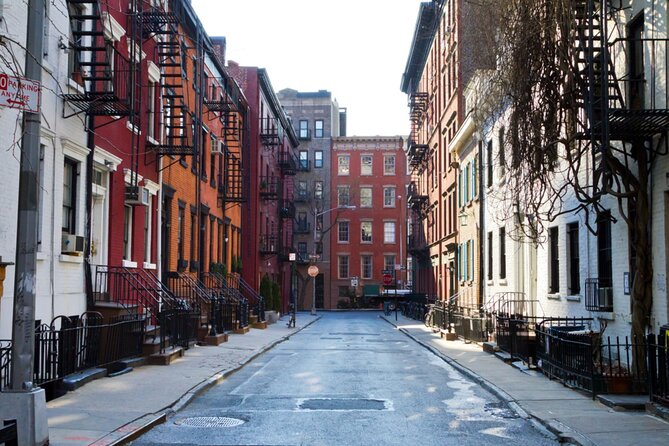
At 40 W 8th St, you learn about the Bon Soir, a small Greenwich Village nightclub owned by Ernie Sgroi Sr. This was the kind of place where comedians and singers like Phyllis Diller, Kaye Ballard, and Ethel Waters performed.
There’s also a striking description of its vibe: it had a remote, forbidden feeling, and you approached it by walking down 31 steps into a square black room. That kind of detail changes how you imagine the evening, even if you never see the interior.
This stop is listed as free, which makes it perfect for a short pause. You can stand on the sidewalk, picture the steps, and let the names do their work. It is a good example of how small facts can make a walk feel like a story.
Washington Square Park: a natural break and a cultural meeting point
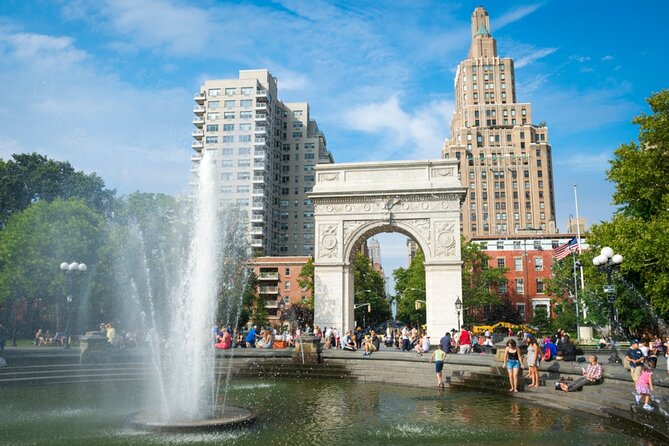
The route gives you a Washington Square Park audio tour moment. Washington Square Park is one of New York City’s best-known public parks, and it is both an icon and a regular meeting place for cultural activity.
I find parks like this do two jobs on a self-guided experience. They give you a break from reading and looking down at your phone, and they also offer a real sense of place. You can listen, reset your energy, and then keep walking with less fatigue.
This stop is marked as not included for admission, so treat it as a park-based moment rather than expecting a ticketed attraction. Also, even though you are playing offline, this is the kind of spot where you can notice street life without needing to hunt for it.
85 W 3rd St: Poe’s presence in the neighborhood air
At 85 W 3rd St, the game pulls in Edgar Allan Poe. Poe was an American writer, poet, editor, and literary critic, and he is especially known for mystery and the macabre. He is often regarded as a central figure in American Romanticism and a major figure in the development of the short story.
This stop works well for readers because it reminds you that literature is not only something you do in bed or at a desk. It connects to actual streets and actual neighborhoods, so you get a “where did the mind live?” kind of feeling.
It is also listed as free, so it fits easily into your pacing. If you want to lean into the literary angle, this is your moment.
Cafe Wha?: early chances for performers who later changed music and comedy
Cafe Wha? is a major stop for anyone who loves music and stand-up. It is described as the place where young performers got early chances to hone their talents, including Jimi Hendrix, Bruce Springsteen, Woody Allen, Lenny Bruce, Bill Cosby, and Richard Pryor.
The club also drew folk singers, artists, poets, beatniks, and anarchists. Even the name has a story, said to be a shortening of what, meant to convey incredulity.
I like this stop because it hits both sides of what makes Greenwich Village special: art and the people pushing it forward. Instead of treating these addresses like monuments, you get a sense of trial, opportunity, and early sets. It is marked as not included for admission, so if you plan to go inside during your visit, you will want to handle that part separately.
158 Bleecker St and the Village Gate: a 1896 structure with layers
At 158 Bleecker St, you learn about the Village Gate, a nightclub at the corner of Thompson and Bleecker Streets. Art D’Lugoff opened the club in 1958 on the ground floor and basement of 160 Bleecker Street.
The building itself is big on context. It is a large 1896 Chicago School structure by architect Ernest Flagg, known at the time as Mills House No. 1, and it served as a flophouse for transient men. In its heyday, the Village Gate also had an upper-story performance space called Top of the Gate.
This stop is listed as free, and it is one of the best places to practice “seeing the layers.” You can look at a structure and realize it did not always host famous performances. Buildings change roles, people pass through, and then a new scene takes over.
Price and value: is $5.98 worth 1 hour 30 minutes?
At $5.98 per person, this is priced like a budget-friendly activity, and it stays that way because you are getting a lot of structure for a small ticket. The key value is not just the route. It is the format: you get flexibility, offline play, and a private group experience without paying for a live guide.
You are also getting a set length, roughly 1 hour 30 minutes, which helps you avoid spending an entire day just trying to “sightsee.” And if you are traveling with a friend or family group, the features include group discounts, which can make the per-person cost even better.
The booking behavior is also a hint about demand. It is typically booked about 27 days in advance on average, so if your schedule is tight, grab it early rather than waiting for last-minute plans.
Who should book this Manhattan artists game
This fits best if you like history that feels practical, not academic. You want street-level context about artists and performers, and you do not want to march in a big group.
I also think it is a solid pick if you are someone who likes to pause and snack. The game format lets you stop when you want, then return to it without losing the whole thread. If you are traveling with someone who gets impatient with long museum visits, this can be a better middle ground.
Because it is private with no human contact and built for avoiding crowds, it is a smart option when you want to be out in the city, but with less social pressure. It also lists most travelers can participate, and service animals are allowed.
Should you book this Manhattan’s Famous Artists exploration game?
Yes, if you want Greenwich Village to feel like a story you can walk through, not a checklist of stops. The best reasons to book are the offline-friendly, self-paced format and the fact that you get specific, named connections to artists like Hendrix, Rotolo, and Poe.
Skip it or treat it as a partial fit if you mainly want a guided indoor experience. A few locations have admission tickets not included, so your “inside the building” goals might cost extra. And because there is no physical tour guide, you will rely on the game itself for context.
If you can handle a phone-based scavenger hunt and you like learning by walking, this is one of those low-stress ways to make Manhattan feel personal.
FAQ
How long does the Manhattan’s Famous Artists exploration game take?
It takes about 1 hour 30 minutes on average.
Do I need an internet connection to play?
No. The game is designed for offline play, so you do not need an internet connection.
What language is the game offered in?
It is offered in English.
Where does the experience start and end?
It starts at White Horse Tavern, 567 Hudson St, New York, NY 10014, and ends at The Bitter End, 147 Bleecker St, New York, NY 10012.
Is there a physical tour guide with me?
No. A physical tour guide is not included, and it is a private, no human contact activity.
Are admission tickets included for all stops?
No. Some stops are marked as admission ticket not included, while others are marked as free.
Is this a private experience?
Yes. It is private, and only your group participates.
Can I get a refund if I need to cancel?
You can cancel for free. A full refund is available if you cancel up to 24 hours before the experience start time.
More Self-Guided Tours in New York City



More Tours in New York City




More Tour Reviews in New York City
Not for you? Here's more nearby things to do in New York City we have reviewed









More Manhattan Tours to consider.
 ★ 4.7Manhattan Helicopter TourTickets from $2997,076 traveller reviews
 ★ 4.8Manhattan Sightseeing Helicopter TourTickets from $2995,826 traveller reviews
 ★ 3.0JFK to Manhattan: One Way Shared Arrival TransferTickets from $313,687 traveller reviews
 ★ 4.5Circle Line: 2.5hr – Complete Manhattan Island CruiseTickets from $343,488 traveller reviews
 ★ 4.6From Manhattan: 4-Hour Dyker Heights Holiday Lights Bus TourTickets from $632,426 traveller reviews
 ★ 3.5Manhattan to JFK: One Way Shared Departure TransferTickets from $312,030 traveller reviews
 ★ 4.5The Manhattan Helicopter Tour of New YorkTickets from $2361,842 traveller reviews
 ★ 3.5Private Transfer from Manhattan to NYC Airports (JFK/EWR/LGA)Tickets from $361,683 traveller reviews
More useful New York routes