

Review · WALKING TOURS
Hamilton and Washington Revolutionary Walking Tour
One walk, two founding rivalries. Lower Manhattan turns into a real timeline when you connect Washington and Hamilton to the streets you actually walk today. You’ll also spot several locations made famous through the Hamilton musical, then hear the straight historical stories behind what you see.
Two things I especially like: the small group size (max 16) keeps the pace human and the narration easy to follow, and the tour is guided by a licensed NYC historian who layers meaning onto each stop instead of just reading facts. One consideration: you’re on your feet for about three hours, and it can mean a lot of standing, so plan for comfort and weather.
Key Highlights You Should Know Before You Go

- Small group: limited to 16 people for a more personal, question-friendly walk
- Licensed narration: a guide with 20+ years experience brings the sites into focus
- Hamilton musical connections: see real locations tied to the show’s characters and events
- Eight major stops: from Bowling Green and Fraunces Tavern to Federal Hall and Trinity Church
- Weather-ready format: runs in rain and snow, unless poor weather forces a change
Lower Manhattan Through Washington and Hamilton’s Eyes

If your idea of Revolutionary history is mostly textbooks and dates, this kind of walking tour changes the texture fast. You’re moving through the southern edge of Manhattan where the early republic started acting like a real power, and where Hamilton’s money brain meets Washington’s leadership story. The tour also gives you a way to see the city as a stage set, not just a place to grab coffee.
I like that the guide narration is built around people, choices, and consequences. You’re not only learning what happened at a famous spot, you’re learning why it mattered, and how those themes still show up today. The story line also has a natural pull if you love Hamilton the musical, because you’ll recognize locations and then get the historical context you might be missing.
One more practical benefit: Lower Manhattan is compact. That makes a 3-hour format workable even if you do not want to plan a full self-guided itinerary across multiple neighborhoods.
You can also read our reviews of more walking tours in New York City



The 3-Hour Route: Bowling Green to Trinity Church
This is an on-foot route that starts at 1 Bowling Green, New York, NY 10004 and ends at Trinity Church, 89 Broadway, New York, NY 10006. Stop times are estimated, but the schedule is designed to keep you moving between major landmarks and plaques that anchor the Revolutionary era.
You’ll likely spend a good chunk of time walking short distances and then pausing at each site for the guide’s explanation. The stops are clustered enough that the tour feels efficient, and that is a big part of the value for your time. It also helps that the tour notes it is near public transportation, so you can stay flexible before and after.
A useful tip: check for days when Federal Hall is closed on weekends. The tour still includes the stop, but the building itself may not be accessible depending on the day you go.
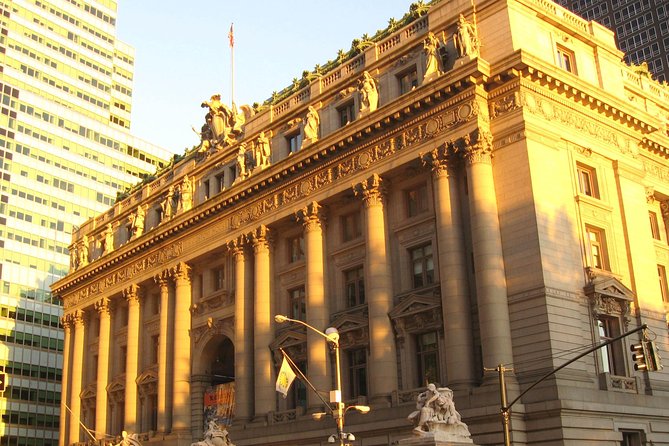
Stop 1: Alexander Hamilton U.S. Custom House and Treasury Power
Your first stop is the Alexander Hamilton U.S. Custom House. This is a strong opener because it frames Hamilton’s role as the first Secretary of the Treasury and shows how much of his influence was about building systems, not just speeches.
Even if you are more into Washington than Hamilton, this stop helps connect the dots. Revolutionaries did not only fight for independence, they also had to figure out how to function afterward. Hamilton’s financial planning is where the new country begins acting like a country, and the building itself adds a sense of legitimacy and place.
The tour includes about 20 minutes here, and it lists an admission ticket not included. So if your plan includes going inside, budget extra time and money based on whatever entry rules are in effect that day.
Stop 2: Bowling Green and the Lead Statue Moment
Next up is Bowling Green, a place that turns quickly from a park-like spot into a Revolutionary War flashpoint. The big story here is the destruction of the 4,000 pound lead statue of King George III, plus the lead-up events that fed into open conflict.
What I like about this stop is how it shows tension in physical form. It is one thing to read about protest and anger, and another to stand at a real landmark and hear how people used public space to make their point. It also sets an emotional tone for the rest of the walk.
This stop is scheduled for about 20 minutes, and the tour lists admission free. That means you get context without adding ticket hassle right at the start of the middle of the route.
Stop 3: Peter Minuit Plaza, Early War Beginnings and Origins
At Peter Minuit Plaza, the story shifts to New York City at the start of the Revolutionary War and to Alexander Hamilton’s origins. This is a pivot stop that helps you connect the city’s early conflict to the people who later became symbols.
The guide narration matters here because the site itself can look modern, while the meaning behind it is tied to a much earlier time. A good guide uses contrast like this well, and the tour is explicitly set up for that kind of storytelling.
You get about 20 minutes at this stop, and it is listed as free with no admission ticket required. If you enjoy walking tours that explain how a place changes over time but keeps a core identity, this is one of the easier stops to appreciate.






Stop 4: Fraunces Tavern Museum and Washington’s Farewell
Then you hit Fraunces Tavern Museum, described as the tavern where George Washington bade farewell to his officers. That is a powerful moment to hear about because it shifts the narrative from battlefield action to the human side of command and transition.
This stop is scheduled for about 15 minutes, and it lists admission ticket not included. So you may be outside or limited depending on what is available, but the guide story should still give you the meaning. The tour also frames Washington’s nearly unprecedented departure as a military leader, which helps make the moment feel less like a postcard and more like a decision with consequences.
Practical note: because entry requirements can vary, it helps to be mentally ready to treat this stop as both a story location and, depending on access, a museum visit.
Stop 5: New York Stock Exchange and Hamilton’s Financial Plan
The tour then moves to the New York Stock Exchange area to connect Hamilton’s financial plan to this institution. The timing makes sense here. You already heard about Hamilton’s Treasury role at the Custom House, and now you see how his ideas link to the idea of American capitalism and public finance.
This is scheduled for about 15 minutes, and it lists admission ticket not included. That usually means you are focused on the story and the exterior context rather than an in-depth ticketed experience.
Still, even without going in, this stop can be useful if you want a real bridge between Hamilton the person and Hamilton the policy. You get a sense of how money, credibility, and national stability were tied together from the beginning.
Stop 6: Wall Street, Bank of New York, and Burr’s Ambitions
At Wall Street, the tour brings up Hamilton’s connection to the Bank of New York and Aaron Burr’s political aspirations. This is where the walk becomes less like a history lecture and more like a character-driven narrative.
Hamilton and Burr are often talked about in big, dramatic terms, and here you get a grounded angle by linking ambitions to institutions and power. The street setting also helps. Even if you are not into finance, Wall Street is a location where you can feel the weight of influence.
This stop is listed for about 20 minutes and is admission free. That is a good rhythm break: you keep moving, you hear a focused story, and you do not have to worry about entry logistics.
Stop 7: Federal Hall, First Capitol and Washington’s Inauguration
Next is Federal Hall, a key site connected to the early Constitution. The tour highlights that this building served as the first Capitol of the United States under the Constitution, hosted the first meeting of Congress, and is tied to Washington’s inauguration.
This stop is scheduled for about 20 minutes, and the tour notes admission ticket not included. It also clearly warns that the building is closed on weekends, so plan accordingly. If you are visiting on a weekend and you were hoping for interior access, adjust expectations and keep your focus on the guide’s explanations outside or on whatever access is possible that day.
I like this stop because it makes the Revolutionary era feel less like a single event and more like a series of steps. Independence is one milestone, but establishing governance is the next one, and Federal Hall is where that shift becomes concrete.
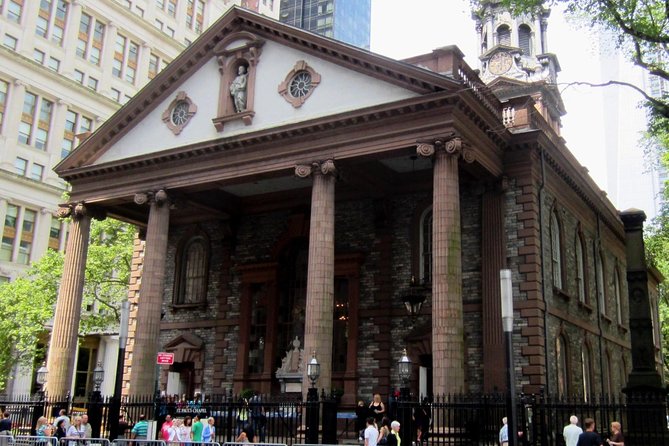
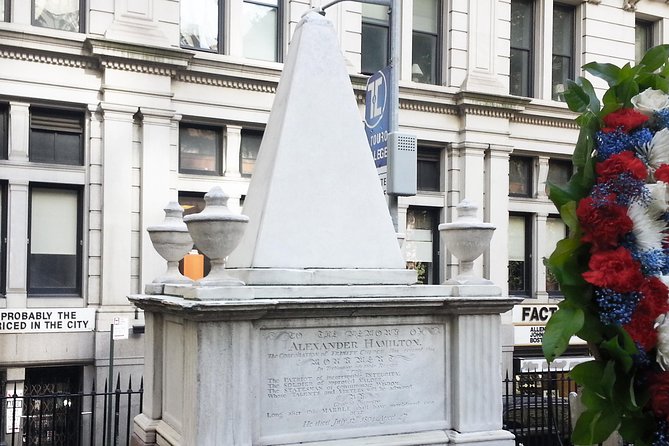
Stop 8: Trinity Church NYC and the Hamilton Family Graveyard
The finale is Trinity Church NYC, including the graveyard where Alexander and Eliza Hamilton are buried, along with other notable Revolutionary War figures such as Hercules Mulligan. Ending here is smart. It takes the story from public institutions and political power to legacy and memory.
This stop is scheduled for about 20 minutes and is listed as admission free. The tour also notes that entry happens on the days and times it is open, so your final experience may depend on the church schedule.
If you love endings with meaning, you will appreciate how this stop gives you a physical place to connect the characters you’ve been hearing about all along. It is the kind of last moment that makes the rest of the walk stick in your mind.
Value for $52.95: Why This Pricing Makes Sense
At $52.95 per person for about three hours, the real question is not the sticker price. It is what you get in exchange for time and money. Here, the value is the guided interpretation plus the efficiency of having a tight Lower Manhattan route handled for you.
A few value points stand out:
- Small group size (max 16), which usually means you can actually hear the guide and ask questions without feeling like a number
- A licensed NYC historian with 20+ years experience, which matters for accuracy and for making the story flow
- A stop sequence that hits both sides of the Hamilton and Washington relationship, not just one theme
Also, the tour uses a mobile ticket, which is handy in a city where you might be juggling reservations, subway stops, and phone battery anxiety. The tour notes it runs in rain and snow, with no cancellations or rescheduling for rain or snow within 24 hours of the start. That reduces the chance that your plans evaporate at the last minute.
What the Best Reviews Reveal About the Experience
The consistent theme in strong feedback is the guide’s clarity and energy. People repeatedly praise the way the storytelling connects to the actual buildings and streets, and they highlight that the guide stays organized and responsive to the group.
You can take that as practical guidance: show up ready to listen, and do not be shy about questions. A guide who handles questions well usually means you will get more out of the walk, not less.
There are also weather realities to plan for. One person noted February cold at the southern tip of Manhattan, and another pointed out a hot, muggy day. Translation: dress for the day you get, not the day you wish for. Bring a layer, wear supportive shoes, and expect that you will be outside for the full route.
Who Should Book This Tour, and Who Might Pass
This is a smart fit if you:
- Love Washington and Hamilton and want the connection between them in a real-world setting
- Want Hamilton musical location tie-ins, but you also want actual history behind the scenes
- Prefer a guided walkthrough instead of figuring it out on your own through scattered plaques and opening hours
It may not be the best choice if you:
- Want mostly seated time. This is a standing and walking tour, and the schedule is built around pacing through eight stops
- Are visiting on a weekend and need access to Federal Hall interior, since it is noted as closed on weekends
- Are sensitive to cold or heat. The tour runs in many weather conditions, so your comfort will depend on what you wear
Should You Book the Hamilton and Washington Revolutionary Walking Tour?
If you want a focused, Lower Manhattan route that turns American Revolution themes into street-level storytelling, I think this tour is a strong booking choice. The combination of a small group, a licensed guide, and a lineup of major Revolutionary era sites makes it feel efficient rather than rushed.
Book it especially if you are traveling with someone who likes history but finds dry lectures boring. This format uses place, character, and cause-and-effect to keep the walk moving. Just plan for the fact that you will be outside and on your feet for about three hours, and you’ll be set.
FAQ
How long is the Hamilton and Washington Revolutionary Walking Tour?
It lasts about 3 hours.
How much does the tour cost?
The price is $52.95 per person.
What is included in the price?
The tour includes a licensed New York City tour guide and historian, plus a smaller group experience limited to 16 people.
Are admission tickets included for every stop?
No. The tour lists admission ticket not included for Alexander Hamilton U.S. Custom House, Fraunces Tavern Museum, New York Stock Exchange, and Federal Hall. It lists admission free for Bowling Green, Peter Minuit Plaza, Wall Street, and Trinity Church NYC.
Is Federal Hall open on weekends?
The tour notes that Federal Hall is closed on weekends.
Does the tour run in rain or snow?
Yes. Tours go out in rain, snow, and shine, and there are no cancellations or rescheduling for rain or snow within 24 hours of the start. The experience requires good weather, and if it is canceled due to poor weather, you will be offered a different date or a full refund.
Are service animals allowed?
Yes, service animals are allowed.
More Walking Tours in New York City



More Tours in New York City




More Tour Reviews in New York City



Not for you? Here's more nearby things to do in New York City we have reviewed












More Walking Tours to consider.
 ★ 5.0SoHo, Little Italy, and Chinatown Walking Tour in New YorkTickets from $393,153 traveller reviews
 ★ 5.0Secrets of Grand Central Station Walking Tour New York CityTickets from $391,796 traveller reviews
 ★ 5.0Greenwich Village Walking and Food Tasting TourTickets from $941,572 traveller reviews
 ★ 5.0Artistic, Alternative Greenwich Village Walking TourTickets from $39971 traveller reviews
 ★ 5.0True Crime NYC: Mafia Walk w/Ret. NYPD Detective and Local FoodTickets from $75848 traveller reviews
 ★ 5.0Central Park Guided Walking TourTickets from $44774 traveller reviews
 ★ 4.6Private Walking Tour with a LocalTickets from $55771 traveller reviews
 ★ 5.0NYC Lower East Side Walking and Food TourTickets from $94646 traveller reviews
More useful New York routes